A general dentist calls and says, “I want a CBCT big enough that I won’t have to buy another one in three years.”
Fair enough. Nobody wants to buy twice. This practice places implants every week, keeps selected endodontic cases in-house and refers orthodontics. So the dentist’s first instinct is to find the biggest field of view on the brochure.
But once we put the practice’s actual procedure mix on paper, the question changes. The office does not need to buy around the rarest case it may refer. It needs a system that can focus tightly when that is all the clinical question requires, cover an arch for implant planning and fit comfortably into the team’s daily workflow.
This is a representative scenario, not a story about one named customer. Versions of this conversation happen all the time. The right CBCT is not automatically the machine with the largest field of view. It is the one with the most useful range for the work you really do.
The short answer: endodontic practices should prioritize small, high-detail volumes; implant, periodontal and general practices usually need flexible small-to-medium volumes; and orthodontic, oral surgery and craniofacial workflows may justify larger coverage. For every patient, the clinical question—not the machine’s maximum capability—should determine the scan selected.
Before You Look at Machines, Make Three Lists
This sounds almost too simple, but it clears up a surprising amount of confusion. Before comparing CBCT and 3D imaging systems, divide your procedures into three groups:
- Procedures you perform every week. These should drive the core configuration.
- Procedures you perform occasionally but intend to grow. These may justify additional FOV, software or modality options.
- Procedures you routinely refer. Do not let these dominate the purchase unless bringing them in-house is part of a real business plan.
Next, write down the five clinical questions you expect the CBCT to answer most often. “We place implants” does not tell an equipment specialist very much. “We evaluate individual implant sites and plan several full-arch cases each month” gives us something useful to work with.
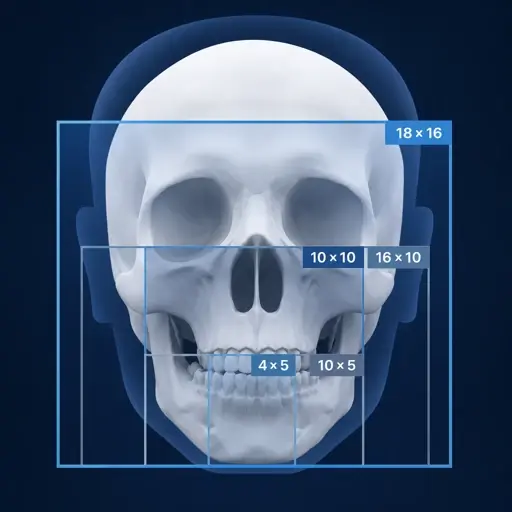
What FOV Fits Each Specialty?
Endodontics: Buy for the Smallest Useful Scan
Practical range to compare: focused volumes around 4×4 to 8×8 cm, paired with high-detail acquisition options.
An endodontist is usually investigating one tooth or a small group of teeth. That means the conversation should begin with the smallest available volume, usable detail, artifact management and review speed—not with how much of the skull the machine can capture.
Ask to see the exact small-FOV protocol in action. “Endo mode” sounds reassuring on a feature list, but the reconstructed image and review workflow are what your team will live with.
Implants, Periodontics and Prosthodontics: Flexible Small-to-Medium FOV
Practical range to compare: approximately 5×5 cm for localized sites through 8×8, 10×8 or 10×10 cm for broader arch planning.
A single implant site and a full-arch reconstruction are not the same imaging job. If you do both, selectable volumes give you more flexibility.
Look beyond the scan, too. Confirm DICOM export, implant-planning tools, surgical-guide workflow and how the CBCT data will line up with your intraoral scans. DuraPro’s guide to digital dental equipment explains how those pieces work together.
For periodontal care, CBCT is not routine imaging for every patient. It may add value when a complex clinical question or implant plan requires three-dimensional information that conventional imaging cannot provide.
General Dentistry: Let the Procedure Mix Set the Ceiling
Practical range to compare: a focused option around 5×5 cm plus medium volumes such as 8×8, 10×8, 10×10 or 12×10 cm.
For many implant-focused general practices, a flexible small-to-medium range is more useful than a large maxillofacial volume. This is where those three lists earn their keep. If orthodontics and major surgery are staying outside your office, you may not gain much by paying for their broadest imaging needs.
Oral and Maxillofacial Surgery: Broad Coverage With a Smaller Option
Practical range to compare: about 8×8 or 10×10 cm for dentoalveolar work, extending to 12×10, 15×15, 17×13 cm or similar coverage for broader maxillofacial applications.
An impacted third molar may call for a limited or medium volume. Orthognathic planning, extensive pathology or facial asymmetry may require much broader coverage—or a different imaging modality altogether.
An oral surgery practice should look in both directions: make sure the machine covers the broad anatomy you need and ask how well it steps down for focused work.
Orthodontics: Large FOV Only When the Case Mix Earns It
Practical range to compare: roughly 12×10 through 15×15 or 17×13 cm when justified, with cephalometric capability where the practice needs it.
CBCT should not be automatic for every orthodontic patient. It can be appropriate for selected questions involving facial asymmetry, impacted teeth, craniofacial anomalies, temporary anchorage devices or surgical-orthodontic care. Verify whether the maximum volume includes the required landmarks and both TMJs in a single acquisition. Also confirm the ceph configuration, low-dose options, analysis software and record-sharing workflow.
Pediatric Dentistry: Child-Specific Capability Matters More Than a Big Maximum
Practical priority: small selectable volumes, stable child positioning and size-appropriate protocols.
Younger patients require especially careful selection because of their greater sensitivity to ionizing radiation. When CBCT is justified, the field and exposure settings should fit the patient and the diagnostic task.
Do not settle for “it has a pediatric setting.” Ask how the machine positions a smaller patient, manages motion and performs at its smallest usable volume.
TMJ and Orofacial Pain: Match the Modality to the Tissue
Practical priority: bilateral bony coverage when both joints must be evaluated.
CBCT is useful for the osseous components of the temporomandibular joints. It is not the preferred examination for every soft-tissue question; MRI is generally the reference modality for disc position, effusion and inflammation. A “TMJ capable” label does not replace a review of the actual volume, positioning and interpretation workflow.
The Number on the Brochure Is Only One Part of the Story
Maximum FOV tells you how much anatomy the system includes. It does not tell you whether the scan is sharp, movement will be a daily headache, metal artifacts obscure the region or the software makes sense to your team.
Even similar dimensions may describe different shapes. An 8×15 cm volume and a 12×10 cm volume do not necessarily include the same landmarks. Ask the equipment specialist to show where each volume sits on a patient. A list of numbers is not enough.
A CBCT Purchase Is Also a Support Decision
We have worked in dental equipment since the early 1990s. We have seen plenty of good purchases—and plenty that looked better on paper than they did in the office.
The difference is rarely one glamorous feature. Installation, calibration, training, parts access and support determine what ownership feels like years later.
That is why we take refurbishment seriously. DuraPro’s certified refurbished equipment moves through a five-stage process on a 10,000-square-foot production floor. On imaging systems, our team inspects the tube head, gantry travel, safety stops, wiring and sensor alignment before calibration and final quality checks. A 50,000-square-foot parts inventory supports current and legacy equipment. The complete process is outlined in the DuraPro Health Refurbishment Standard.
Our published warranty terms provide at least one year of parts coverage and 90 days of workmanship coverage for used and refurbished equipment; confirm the exact coverage on the quote. DuraPro also offers complimentary technical support and coordinates dental equipment delivery and installation across all 50 states.
“We stand behind our equipment” is easy to say. The operation behind it is what matters. DuraPro carries more than 80,000 products, maintains an A+ Better Business Bureau rating and reports third-party review averages typically at 4.5 stars or better. Learn more about DuraPro Health or read DuraPro Health customer reviews.
Return to the Practice That Wanted to “Never Upgrade”
So what would we tell the dentist from the beginning of this article?
The practice’s weekly implant work and selected endodontic cases point toward a system with strong focused and medium-volume performance. The orthodontic and airway cases it refers do not automatically justify buying the largest platform.
The honest recommendation may be a machine with room to grow. It may also be a decision not to pay for a workflow the practice rarely uses. Either is better than starting with “largest FOV” and justifying it afterward.
That is the difference between selling a specification and helping a practice choose equipment: one begins with the brochure; the other begins with the work.
Questions to Put on the Quote
- What are all selectable FOVs on this exact configuration?
- What is the smallest volume, and what detail is available at that size?
- Does the broadest volume include the landmarks required for our justified cases?
- Which panoramic, cephalometric or low-dose options are included—and which require a license?
- How do images move into our planning, scanner, lab and referral workflows?
- Who handles room review, installation, training, calibration and service?
- What warranty applies to the exact unit on the quote?
Frequently Asked Questions
Is an 8×8 CBCT enough for implant dentistry?
It may cover many arch and multi-site cases, depending on patient anatomy and the unit’s volume placement. A smaller selectable field remains valuable for localized sites, while some sinus, grafting or maxillofacial questions may require broader coverage.
Does an endodontist need a large-FOV CBCT?
Usually not for the core endodontic workflow. The smallest available volume, high-detail performance and artifact management generally matter more. A broader option can serve a multi-specialty office, but it should not replace a focused acquisition when a limited region answers the question.
Can a large-FOV CBCT also take small scans?
Many can, but capabilities differ by model, configuration and software license. Confirm every selectable FOV and protocol on the exact machine being quoted.
What is the best CBCT for a multi-specialty practice?
Look for a system that covers the practice’s common focused and medium-volume work, then add large-FOV or ceph capability only where the case mix justifies it. Standardized software, training and support may matter as much as the maximum scan size.
Choose Around the Work You Actually Do
The right field-of-view range sits at the intersection of specialty, procedure mix, patient selection, software and support. In plain English: buy enough capability for the cases you plan to keep, but do not let an occasional “maybe someday” case make the decision for you.
Once the system is in your office, choose the smallest appropriate acquisition for the individual patient and clinical question.
If you want help narrowing the field, bring us your weekly, growth and referral lists, room dimensions and digital workflow. We will walk through the options with you—without assuming that bigger is better.
What CBCT Field of View Do You Need for Your Specialty?